

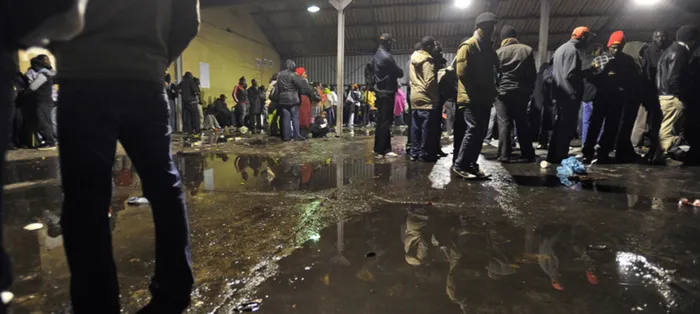
DESPERATE WAIT: Refugees seeking asylum permits queue in a warehouse outside the Maitland Refugee Centre in the early morning. More than a thousand refugees queue on some days, arriving at 4am in an attempt to get their permits. Picture: BRENTON GEACH DESPERATE WAIT: Refugees seeking asylum permits queue in a warehouse outside the Maitland Refugee Centre in the early morning. More than a thousand refugees queue on some days, arriving at 4am in an attempt to get their permits. Picture: BRENTON GEACH
Grace Huang
Corruption, abuse, inefficiency and incompetence plague the two-year-old Maitland Refugee Centre and prevent Home Affairs officials from adequately serving refugees, forcing them to queue for months.
In some cases, the delay causes permits and passes to expire, forcing refugees to pay huge fines or risk arrest and deportation through no fault of their own.
This is according to a report released by People Against Suffering, Oppression and Poverty (Passop) on Tuesday, which monitored the Maitland centre for two weeks last month.
The centre opened in 2009 after relocating from Nyanga.
More than 1 600 refugees were turned away during the study. Most of them were Zimbabwean, Congolese and Somali. Almost 40 percent were refused because the centre had no forms or there were too many people. According to the monitors, more than half were newcomers, or first-time asylum seekers.
More than 20 percent of the 1 600 were refused because they lacked a border pass – a permit obtained upon entering South Africa that allows one to legally remain in the country while seeking asylum status. However, such a pass is not required to apply for asylum.
“If they did not receive a pass or entered the country in a clandestine manner, they should not be barred at the centre from applying for asylum,” Fatima Khan, director of the refugee law clinic at UCT, said. “It’s national and international law.”
The report called the figures a “low estimate” as they could not speak to every individual despite their efforts.
“In other provinces, it’s the same or worse,” Passop co-ordinator Braam Hanekom said.
According to Home Affairs statistics, an average of 508 newcomers and 5 379 refugees seeking renewals were served every two weeks in 2011.
Home Affairs said it would study the report’s findings and formulate a comprehensive response.
“The Department is in the process of reviewing its refugee and immigration policy,” it said, adding that the amendments to the Refugee and Immigration Acts would streamline and fast-track the application process for refugees. The report also pointed out that the border passes, which lasted for 14 days, now lasted only five days because of a recent amendment to the Immigration Act of 2002. Refugees who have not obtained permits within this period must leave the country or face fines, arrest and deportation.
However, refugees can only queue one day a week, depending on nationality, under centre policy. Added to the other issues at the centre, this means that refugees are unlikely to receive permits in time, the report concludes. Without these permits, refugees cannot have access to bank accounts or get jobs, and face arrest and deportation.
Alaina Varvaloucas, a Passop monitor, said Home Affairs had repeatedly denied refusing individuals without the pass. But, she suspects, the passes allow some to make illicit profits.
“It leads to lots of money-making opportunities,” she said.
When the Cape Times and Passop monitors visited the centre at various points over the past two months, both encountered days when guards required the pass and, more recently, days when they did not.
The monitors witnessed people paying security guards to let them cut the queue and men outside selling fake papers – profiting from how the centre has turned away people without a border pass.
“Anecdotal evidence suggests that these men have ‘connections on the inside who share in the profits’,” the report notes, adding that one refugee told monitors he had the phone number of an official inside the centre given to him by a seller.
Prices are also inconsistent. Refugees have been quoted prices of R20 to R500 for border passes and up to R3 000 for permits. Refugees seeking renewals can make it through the queue in one day without any problems – or are stuck in the queue for days and quoted prices upwards of R1 000 by sellers.
Guards also treated refugees badly, especially on the Tuesdays that Somalis queued.
When Varvaloucas visited the centre on Tuesday morning, she said, she saw guards armed with sticks and rubber whips who sometimes hit the queuing refugees.
Refugees seeking renewals of their permits also face challenges. If their temporary permits expire while queuing, they still must pay R2 500 in fines.
grace.huang@inl.co.za